Being injured is the part of cricket nobody prepares you for. Not the pain, which you can deal with, but the boredom and the strange status of being a player who is not playing. The season carries on without you. Other people are training for the thing you were supposed to be in the middle of.
There is a real risk in that period, and it is not that you will get weaker. It is that you will go quietly out of the habit of working. The fitness work is supervised, the rehab is supervised, but the mental habit of being a cricketer tends to evaporate quietly, and it is often the thing that has not recovered by the time the body has.
The books below are for that gap. Every title was checked against Audible’s catalogue before publishing, so the runtimes and narrators below are current, and every link goes to the exact product.
Listen to Cricket's Greatest for Free —
Keep your first audiobook forever.
Start a 30-day Audible trial and download biographies of Kohli, Warne, Tendulkar, or elite sports psychology books.
The facts
| Audiobook | Who it is for | Length | Read by |
|---|---|---|---|
| The Art of Mental Training D. C. Gonzalez | Anyone who needs something short and practical this week | 2 hr 57 min | D. C. Gonzalez |
| The Mindful Athlete Audio Companion George Mumford | Players whose head needs a reset rather than a plan | 1 hr 50 min | George Mumford |
| The Inner Game of Tennis W. Timothy Gallwey and Pete Carroll – introduction | Players who need to stop narrating their own mistakes | 4 hr 36 min | Dan Woren |
| Grit Angela Duckworth | Players whose season has been derailed and who need a reason to keep going | 9 hr 22 min | Angela Duckworth |
| Mindset Carol S. Dweck | Players who need to redefine what success means for this season | 10 hr 23 min | Bernadette Dunne |
| Atomic Habits James Clear | Anyone whose rehab needs to become a routine rather than a project | 5 hr 35 min | James Clear |
| The Art of Learning Josh Waitzkin | Players who want to use the downtime to get better at learning | 7 hr 55 min | Josh Waitzkin |
| Second Innings Andrew Flintoff | Anyone whose career has had a second half already | 5 hr 52 min | Richard Burnip |
| Open Andre Agassi | Players who want the long version of a career rebuilt from scratch | 18 hr 4 min | Erik Davies |
What it covers
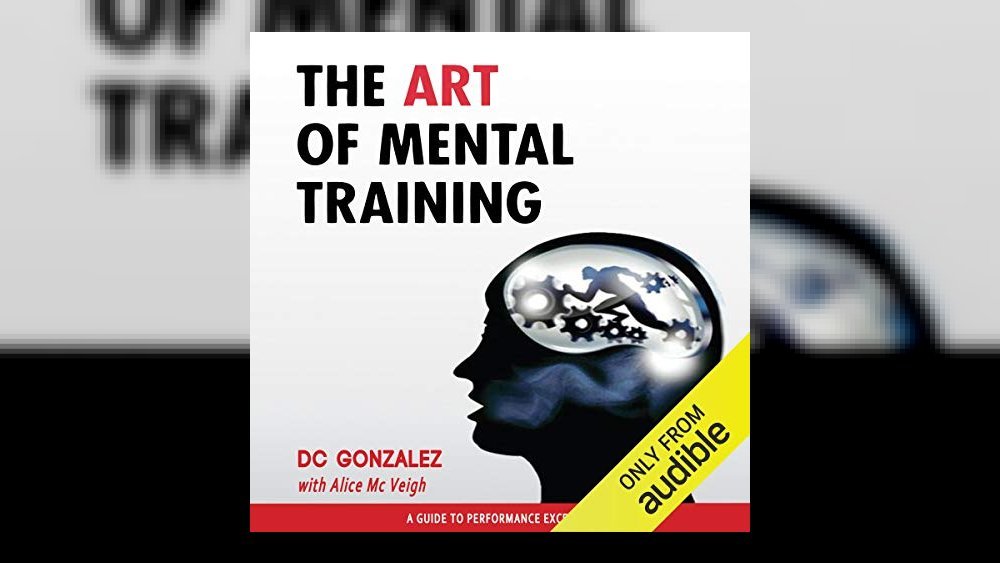
The Art of Mental Training

The Art of Mental Training is the shortest serious book here and the one most likely to get finished during a rehab. Under three hours, narrated by the author, and structured as a manual rather than an argument.
Gonzalez is a performance coach and the material is deliberately unglamorous: how to prepare for a session, how to hold focus when the session is bad, and what to do on the days you would rather not train. That last part is the one that matters when you are injured, because the correct answer is usually a smaller session, not a missed one.
There are drills at the end of each section. Most of them are mental rather than physical, which makes them the right shape for a period when you cannot train.
Read by D. C. Gonzalez · GonzoLane Media. Listen on Audible
nnThe Mindful Athlete Audio Companion

George Mumford’s Mindful Athlete is an audio companion, not a full book, and at one hour and fifty minutes it is the shortest thing on this list. It works because it asks for very little: attention, breath, and the recognition that most of what you do under stress is not the thing you think you are doing.
Mumford has worked with a lot of elite American athletes, and the material translates. The specific application during a rehab is straightforward. The work of noticing your own reaction is something you can do lying down, and it is closer to the mental skill you will need in a long, slow comeback than most cricket books would suggest.
Worth listening to twice, and worth buying the version with the full track listing if you want to jump to the breath work.
Read by George Mumford · BetterListen. Listen on Audible
nnThe Inner Game of Tennis
The Inner Game of Tennis is the oldest book on this list and it is still the sharpest description of what happens between a decision and the movement that carries it out. Gallwey calls the instruction you give yourself while you are performing the second self, and argues that most people are trying to run two of them at once.
That is exactly the state a recovering player is in. The body is doing something slow and prescribed, there is nothing useful to do physically, and the mind fills the gap with commentary about how much you are missing.
Under five hours, and it is the book most likely to be re-read by people who found it unhelpful the first time.
Read by Dan Woren · Random House Audio. Listen on Audible
nnGrit

Angela Duckworth’s Grit argues that sustained effort over long periods predicts who finishes difficult things better than talent does, and she backs it with her research on West Point cadets, where grit predicted completion better than class rank or physical aptitude.
There is an obvious misapplication of this book, which is to treat a comeback as a test of toughness. It is not. It is a test of structure, and the structure is something you build with your physio and your coach while you are still in the sling.
Read by the author, and the first two hours are enough to get the argument. The case studies that follow are where you will find something for the months ahead.
Read by Angela Duckworth · Simon & Schuster Audio. Listen on Audible
nnMindset
Carol Dweck’s Mindset is a book about how people interpret difficulty, and it is more directly useful during a long injury than it might appear. The distinction Dweck draws is between treating a setback as evidence about your ability and treating it as information about your current state.
Read the research chapters with some scepticism. Dweck has been rightly criticised for overstating what the mindset experiments show, and the popular summaries of this book oversell it. The underlying idea, that your interpretation of a setback changes what you do next, is well supported and worth taking.
Ten hours and twenty-three minutes. The first third is the argument; the rest is application and it is the application you will want.
Read by Bernadette Dunne · Random House Audio. Listen on Audible
nnAtomic Habits

Atomic Habits is the most-cited book in this list and the most over-recommended, so it is worth being clear about what it actually offers. Clear’s argument is that behaviour change comes from making the desired action obvious, attractive, easy and satisfying, and that you build a habit by changing the environment rather than by resolving to be different.
Applied to a rehab, that is a genuinely useful reframing. The person who puts the equipment out the night before does not have more willpower than the person who has to dig it out of a cupboard. Same for the season of general conditioning that most injured players do not do and wish they had.
Five hours and thirty-five minutes, read by the author. Skip it if you have already read it; it will not feel new.
Read by James Clear · Penguin Audio. Listen on Audible
nnThe Art of Learning
Josh Waitzkin won the US National Chess Championship at nine, and The Art of Learning is his account of what actually produced that, which is not what people assume. The book is about how to learn a hard skill deliberately, and about how most people practise the easiest version of the thing they are trying to learn.
There is a specific idea here that matters for a player rebuilding: separate what you are learning from what you are performing. The two look identical from the outside and they are not, and confusing them is how people spend a winter repeating what they can already do.
He reads it himself, at close to eight hours. The chapter on how to study is the one worth your time.
Read by Josh Waitzkin · Tim Ferriss. Listen on Audible
nnSecond Innings
Andrew Flintoff’s Second Innings is an autobiography that happens to be about the most relevant thing on this list, because a second innings is a second career. Flintoff had a career-ending injury, rebuilt, had a second peak including an Ashes summer, and then had to build something again afterwards.
The honest parts are the best parts. He writes about what the comeback actually cost, including the years when the body was there and the confidence was not, and about the strange difficulty of being a returning player in a dressing room that has moved on.
Read by Richard Burnip, just under six hours. It is the closest thing on this list to a description of what you are going through.
Read by Richard Burnip · Hodder & Stoughton. Listen on Audible
nnOpen
Open is Andre Agassi’s autobiography and it is eighteen hours long, which is worth knowing before you start. It is also the most ruthlessly honest sports autobiography of the last thirty years, and it is not a cheerful book.
The reason it is here is the middle section. Agassi describes a period in which his entire identity had collapsed into one failing part of his game, and the process of deciding whether to rebuild everything or quit. That is more recognisable to a cricketer in a sling than the tournament chapters people usually remember the book for.
Do not start it during the worst weeks. Start it when you are ready to be uncomfortable on purpose, and expect the narration to be unflinching.
Read by Erik Davies · Random House Audio. Listen on Audible
nnWho it is for, and who it is not
This is for a cricketer who is injured and sidelined, or who has come back and is trying to get back to the level they were at. It also works for a player who has been out of the game for a season and knows that the thing they have lost is not fitness but routine.
For a strength and conditioning coach or a physio, the useful section is the one on what a player is actually doing mentally during a rehab that is mostly waiting. The books here describe that period in more detail than most medical literature does.
How to get the most from it
Use the time to build a habit you will want later, not to catch up. The most common outcome of an injury is not a stronger player, it is a player who returns to the same old habits, and habits are much easier to install than to reinstall.
Keep a single fixed slot. Twenty minutes in the same place on the same days is enough, and it is far better than an ambitious weekend that does not happen. The aim is that this is still normal in eight weeks.
Stay connected to the team, but on your own terms. A player who is in the dressing room for every session and is not in the team tends to recover worse than one who accepts the situation and builds a life around it.
Watch for the drift in your attention. There is a particular kind of low mood that arrives around the second month, when the novelty has gone and the return is still far away. Recognising it early is most of the management.
- Pick one fixed slot and protect it: twenty minutes, same place, same days.
- Build something you will still want after you are fit: the habit survives, the injury does not.
- Write down what you are learning: rehab is the one period in a career with unstructured time to think.
- Set a date for the thing you are working towards: even a rough one gives the weeks a shape.
- Keep the physical work visible: a written log makes progress legible on the bad days.
Common questions
What should I listen to while I am injured?
The Mindful Athlete Audio Companion to start, because it is under two hours and asks nothing of you except attention. The Art of Mental Training is the better second choice, because it is a manual with drills you can use while you are stuck on a machine that is not going anywhere. Both are short enough to finish inside a realistic rehab, which is the test most book lists fail.
Will reading help me physically recover faster?
No, and you should be sceptical of anyone who says so. Your tissue healing is a biological process and a book does not touch it. What a book can affect is the mental side of the same period: whether you keep training the other parts of you, whether you stay connected to the game, and whether the boredom of the wait turns into something corrosive. That matters, but it is a different claim from faster recovery.
Is Second Innings the right book for me if my injury has ended my career?
It is honest about the parts that are hard, which is its strength. Flintoff did not come back the same, and he does not pretend the comeback was a straight line. Whether that is useful depends on what you want from a book. If you want reassurance, it will not give it to you. If you want an accurate account of what the process is like, it is the best available.
How do I stop feeling guilty about being injured?
You probably cannot stop it entirely, and it is worth saying that professional cricketers feel this too and most of them are not discussing it in public. The practical counter is to separate what was luck from what was your decision. Some injuries are simply what happened. Some come from workload, and the difference is usually knowable and is the only part worth working on. The Mindful Athlete is the book on this list that addresses the feeling directly rather than the reasoning.
Is there anything worth listening to for the mental side of coming back?
Yes, and The Inner Game of Tennis is the best place to start. Its whole subject is the difference between the instruction you give yourself and the instruction you meant to give yourself, which is precisely what goes wrong when you return to a game you have been away from for months. It is also one of the shorter books here, so it is an easy one to actually complete.
Written by the CricketGearGuru editorial team. Every title above was checked against Audible’s own catalogue on the day this page was published, so the narrator, the running time and the edition are the current ones. The links are affiliate links, so we may earn a commission if you buy through them at no extra cost to you.